
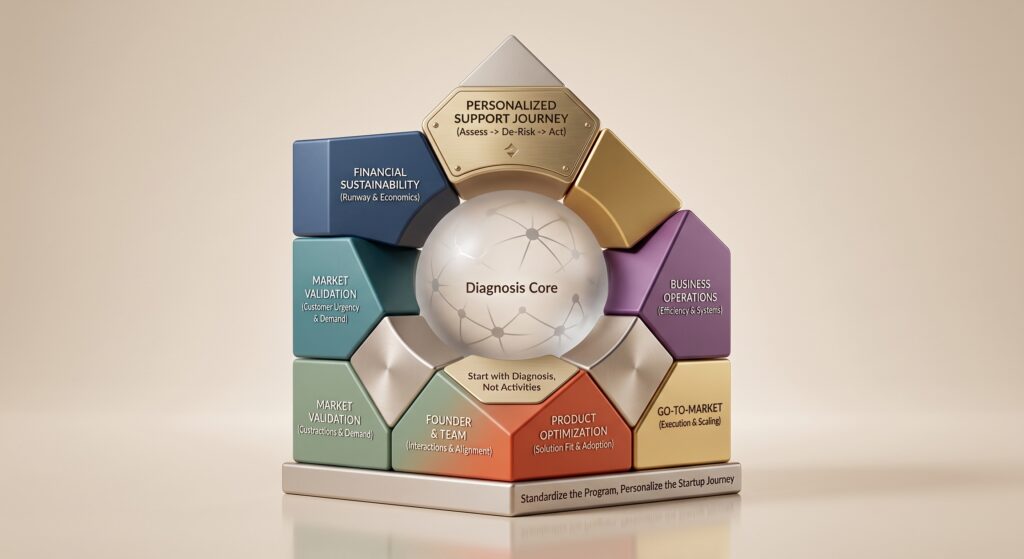
Entrepreneurship programs need personalized support because startups that look similar can have very different risk structures. One company may have strong market demand but founder or team problems; another may have a strong team but weak product validation or financial sustainability. Standardized programming cannot address those differences effectively.
Entrepreneurship programs are often built around a cohort model. Founders enter together, participate in a common curriculum, attend workshops, meet mentors, and progress through a defined program.
There are good reasons for this structure. It creates efficiency, community, shared learning, and a consistent experience.
But there is a fundamental problem: startups may enter the same program without needing the same support.
Two companies can be at the same stage, operate in similar markets, and even have comparable traction while carrying very different combinations of risk.
That is why personalized startup support matters.
The Same Stage Does Not Mean the Same Needs
Consider three startups entering the same accelerator program.
The first has a strong founding team and promising product but little evidence that customers consider the problem urgent enough to pay for a solution.
The second has demonstrated meaningful demand but has serious disagreement among its founders.
The third has customers, a capable team, and a functioning product, but its economics and cash position make its current growth trajectory difficult to sustain.
All three might be described as early-stage startups.
But telling them to focus on the same things would make little sense.
The first needs stronger market evidence. The second has founder or team risk that could undermine everything else. The third may need to address financial and operational sustainability.
Startup stage alone does not determine startup needs. Risk does.
Personalization Should Start With Diagnosis
Personalized support is sometimes interpreted as simply giving founders access to different mentors, resources, or content based on what they request.
That can be useful, but there is a limitation: founders do not always know where their greatest risks are.
Some risks are obvious. Others emerge from interactions between different parts of the company or remain hidden until their consequences become much harder to address.
This is why Rocketbeet’s approach begins with diagnosing before prescribing.
Juan Damia’s De-Risking Startups Framework™ evaluates startup risk across six interconnected dimensions: Founder, Team, Market, Product, Business Operations, and Finance.
Rather than asking only what a founder wants help with, the objective is to understand the startup as a system and determine what deserves attention now.
That diagnosis provides the foundation for meaningful personalization.
From Generic Advice to Personalized Action
Once the most important risks have been identified, support can become much more specific.
A market-risk issue might lead to actions designed to validate customer urgency, willingness to pay, or market accessibility.
A team problem may require very different actions around responsibilities, accountability, incentives, or decision-making.
Product risk could require evidence about adoption or whether the solution actually addresses the problem identified.
Financial risk might shift the immediate priority toward runway, unit economics, or the sustainability of the company’s growth.
The objective is not to create a different entrepreneurship curriculum for every founder.
It is to translate the company’s specific risks into personalized priorities and actions.
Personalized Support Makes Mentoring More Relevant
The same principle applies to startup mentoring.
A mentor can create more value when the session begins with an understanding of the company’s current condition, risks, and priorities.
Instead of spending valuable time discovering the basic situation, mentors can focus on the questions where experience and judgment matter most.
Personalization can also improve mentor allocation.
A company facing a go-to-market problem may benefit from a different mentor than one struggling with organizational structure or financial sustainability. Understanding startup needs before matching resources makes the entrepreneurship program itself more efficient.
Can Personalized Startup Support Scale?
Historically, personalization has been expensive.
Supporting ten startups individually is manageable. Providing the same level of diagnosis and follow-up to 100 or 500 companies is much harder.
This is where technology can change the economics of entrepreneurship programs.
Structured startup assessment, risk identification, prioritization, personalized action planning, and progress monitoring can automate parts of the process that do not require human judgment.
Rocketbeet’s Founders OS was designed around this model: technology provides the individualized startup-development layer, while program managers and mentors concentrate their attention where human expertise creates the most value.
Personalization therefore does not necessarily mean adding more staff or mentoring hours. It means using available resources more intelligently.
Standardize the Program, Personalize the Startup Journey
Standardization and personalization do not have to be opposites.
Entrepreneurship programs can maintain a common curriculum, shared workshops, cohort experiences, events, and milestones while personalizing what each startup should prioritize between those activities.
The program can remain standardized.
The startup journey does not have to be.
This is particularly important for universities, accelerators, incubators, and other organizations trying to support more founders without sacrificing the quality of that support.
If startups have different risk structures, effective entrepreneurship programs need a way to recognize those differences.
The goal of personalized startup support is therefore not to give every founder everything they ask for. It is to understand what each company needs most, direct the right resources toward those needs, and continuously adjust those priorities as the startup evolves.