
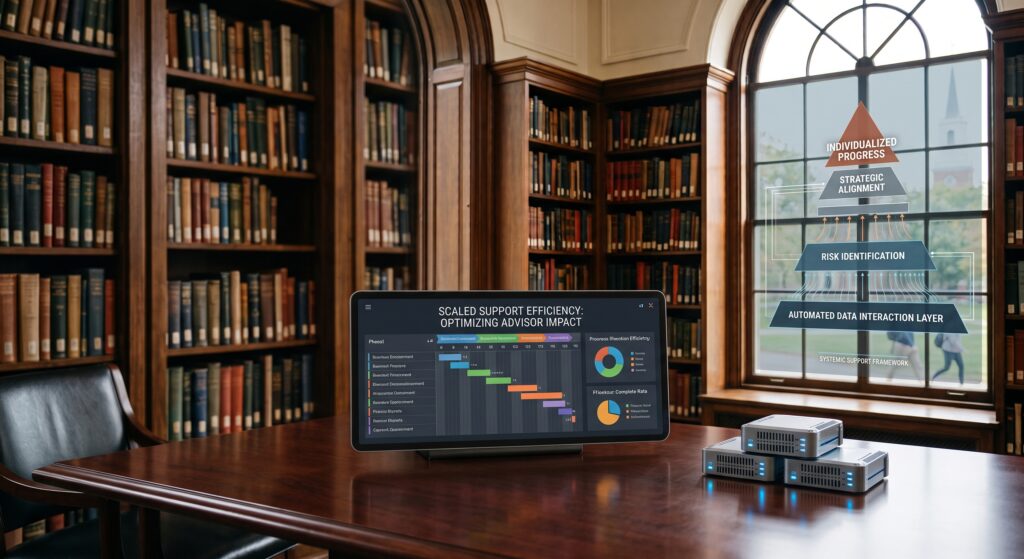
Entrepreneurship programs can support more startups without adding more mentors by using technology for the parts of startup support that do not require human judgment, including structured assessment, risk identification, progress tracking, and prioritization. Mentors can then spend more of their limited time on the decisions and situations where their experience creates the greatest value.
For many entrepreneurship programs, growth creates a difficult tradeoff.
A university, accelerator, incubator, or economic development organization may want to support more founders, but individualized startup support traditionally requires more staff and more mentor hours.
As the number of startups increases, program teams have less time to understand each company. Mentoring capacity becomes constrained. Follow-up becomes more difficult. And startups that need attention can become harder to identify.
The traditional solution is to increase mentor capacity.
Technology creates another possibility: increase the productivity of the mentoring capacity the program already has.
Not Every Part of Startup Support Requires a Mentor
Mentors are particularly valuable when founders need experience, judgment, perspective, specialized expertise, introductions, or help making difficult decisions.
But mentors also spend time gathering information.
What stage is the company at? What has changed since the last meeting? What assumptions remain unresolved? What has the founder completed? Where is the company struggling? What should be discussed first?
Much of that work can be structured before a mentor enters the conversation.
At Rocketbeet, our approach is to separate the parts of startup support that can be systematized from those where human judgment creates the greatest value.
Technology can support startup assessment, risk identification, prioritization, personalized action planning, and progress monitoring.
Mentors can focus on what technology cannot replace as easily: judgment.
Diagnose Before Using Mentor Capacity
A common challenge in startup mentoring programs is that the founder, program manager, and mentor may not begin with the same understanding of the company.
This can make the first part of a mentoring session diagnostic.
Rocketbeet’s principle of diagnosing before prescribing changes that sequence.
Using Juan Damia’s De-Risking Startups Framework™, a startup can be assessed across Founder, Team, Market, Product, Business Operations, and Finance. The objective is to identify the risks that deserve attention and translate them into priorities before deciding which resources should be applied.
This gives entrepreneurship programs another way to think about mentor allocation.
Instead of asking:
Which mentor is available for this startup?
the program can first ask:
What does this startup need, and whose expertise is most relevant to that need?
Better Information Can Make Mentoring More Effective
Imagine a mentor has one hour with a founder.
If the first 20 minutes are spent understanding the company’s basic situation, a significant part of the available mentoring capacity has already been consumed.
Now imagine that the mentor begins with visibility into the startup’s current condition, its highest-priority risks, recent progress, and the actions the founder is working on.
The conversation can begin at a different level.
The mentor can challenge an assumption, examine evidence, help evaluate alternatives, or apply experience to a difficult decision.
The objective is not simply to increase the number of mentoring sessions.
It is to increase the value of each mentoring session.
Use Technology to Identify Who Actually Needs Attention
Scaling startup support also requires recognizing that not every company needs the same level of human attention at the same moment.
Some startups may be progressing well against their priorities. Others may be stagnating, disengaging, or accumulating significant unresolved risks.
Without systematic visibility, program managers may discover those differences through meetings, founder requests, mentor feedback, or when a problem has already become obvious.
Technology can help entrepreneurship programs continuously monitor startup progress and surface companies that require attention.
This enables a different management model:
Use human attention where human attention is most needed.
Personalization at Scale
The challenge becomes even greater when entrepreneurship programs want to provide personalized startup support.
Personalization traditionally implies more manual work. Every startup needs to be understood, priorities established, actions defined, progress reviewed, and support adjusted.
Rocketbeet’s Founders OS is designed to automate much of this startup-development layer. It helps programs assess companies, identify risks, generate personalized De-Risking Action Plans, monitor execution, and maintain visibility across the cohort.
Program managers and mentors remain central to the process, but they no longer have to manually perform every step for every startup.
This is particularly relevant for university entrepreneurship programs, accelerators, incubators, and other organizations supporting large startup cohorts.
Scaling Support Is Different From Scaling Activities
Entrepreneurship programs can scale activities relatively easily.
A workshop that serves 20 founders may be redesigned to serve 100. Online resources can reach thousands. Events and content can be distributed broadly.
Individualized startup support is harder to scale because every company is different.
That is where entrepreneurship program technology can have a greater impact.
The objective should not be to automate the human relationships that make entrepreneurship ecosystems valuable. It should be to automate enough of the surrounding assessment, monitoring, and prioritization that those relationships can be used more effectively.
For entrepreneurship programs, the opportunity is therefore not simply to support more startups with fewer mentors.
It is to build a model where technology handles what can be systematized and mentors spend more of their time doing what requires human experience, expertise, and judgment.