
No. Entrepreneurship inherently involves uncertainty. Startup de-risking is therefore not an attempt to create a risk-free startup. The objective is to identify risk earlier, reduce unnecessary exposure, validate assumptions, and preserve the company’s ability to respond as conditions change.
Every startup makes decisions without knowing exactly what will happen next. Founders cannot know with certainty how customers will behave, how competitors will respond, whether a product will scale as expected, which employees will perform well, how markets will change, or when external conditions will shift.
Some of that uncertainty can be reduced through evidence and experience. It cannot be completely removed.
A startup without uncertainty would no longer really be operating like a startup. It would be executing a fully understood and predictable business model—and early-stage companies rarely have that luxury.
The objective of startup de-risking is therefore not to eliminate risk. It is to manage uncertainty before it becomes irreversible.
Some Risk Is Unavoidable
Every meaningful startup decision involves assumptions. A company may have strong evidence that customers want its product, but it cannot know exactly how demand will develop. It may have an excellent team, but it cannot predict every organizational challenge that will emerge as the company grows. It may have sufficient capital today while remaining exposed to future changes in revenue, burn, fundraising conditions, or market behavior.
Founders must act despite those uncertainties. Waiting until every variable is known would often mean never making the decision at all.
The question is therefore not:
“How do we eliminate this risk?”
A better question is:
“How much uncertainty can we responsibly carry while continuing to learn?”
That distinction is central to Juan Damia’s De-Risking Startups Framework™.
Trying to Eliminate Risk Can Create More Risk
It may sound counterintuitive, but attempting to eliminate every possible startup risk can make the company less resilient.
Imagine a startup trying to eliminate operational risk by building sophisticated processes for every possible future scenario. The company may create systems it does not yet need, hire people before their roles are justified, add management layers, and slow decision-making.
One category of risk decreases, but complexity, cost, and rigidity increase.
The same problem can occur with product development. A company trying to eliminate every possible technical uncertainty before launching may spend enormous amounts of time and capital building capabilities customers do not actually need.
The startup becomes technically prepared for possibilities that may never happen while consuming the resources it needs to discover what actually matters.
De-risking should reduce unnecessary exposure without eliminating the startup’s ability to move, learn, and adapt.
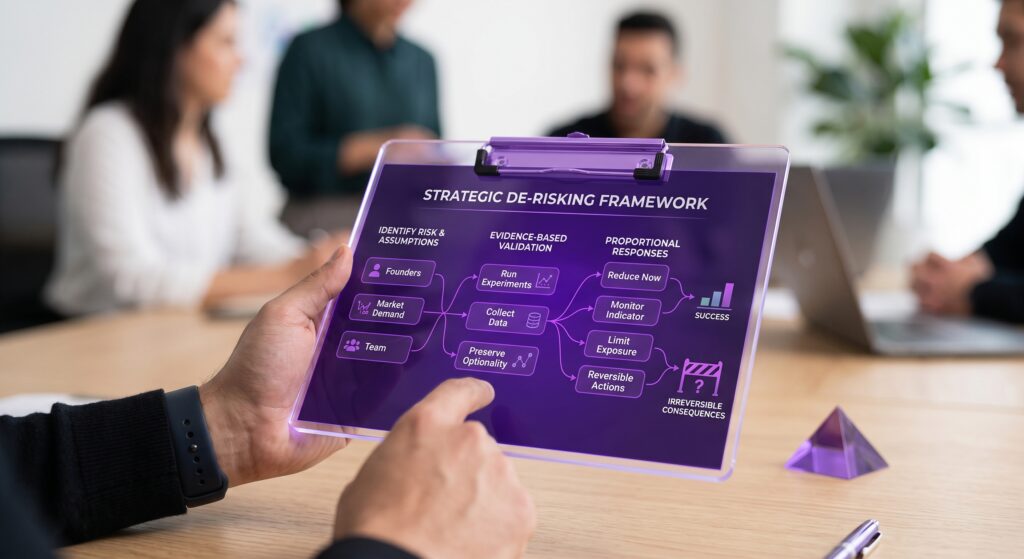
Risk Responses Should Be Proportional
This is why proportionality is an important principle in the De-Risking Startups Framework™.
Not every identified risk deserves the same response.
Some risks require immediate action because their consequences could be severe or difficult to reverse. Others should be reduced gradually as the startup learns more. Some simply need to be monitored until additional evidence appears.
The appropriate response may be to:
- Reduce the risk immediately.
- Run an experiment to validate the underlying assumption.
- Limit the company’s exposure.
- Create a contingency.
- Monitor an early warning indicator.
- Delay an irreversible commitment.
- Accept the risk consciously.
The objective is not to respond maximally. It is to respond appropriately.
Validation Reduces Uncertainty
Startups begin with assumptions, but those assumptions do not all need to remain assumptions.
They can be tested.
A founder who believes customers will pay a particular price can test pricing before building an organization around that assumption. A startup uncertain about a market can test demand before committing heavily to expansion. A company considering significant hiring can first determine whether the underlying workload is repeatable.
Each meaningful validation replaces some uncertainty with evidence.
This is how startups reduce risk without pretending to eliminate it.
The objective is to shorten the distance between an important assumption and the evidence required to make a better decision.
Preserve Optionality
Another reason startup risk should not be approached as something to eliminate is that aggressive risk reduction can consume optionality.
Optionality is the startup’s ability to choose among different courses of action as new information appears.
A company that commits too much capital too early has fewer choices later. A startup that builds an overly rigid technology architecture may find adaptation expensive. A company that hires ahead of validated demand creates financial commitments that are difficult to reverse.
Sometimes the safest-looking decision today creates greater risk tomorrow because it reduces the company’s ability to respond.
Effective de-risking therefore asks not only:
“Does this action reduce the risk we see today?”
but also:
“What options will we still have if our assumptions change?”
A good risk response protects the company without unnecessarily constraining its future.
The Objective Is Reversibility, Not Certainty
Early-stage startups rarely have enough information for certainty. But they can often design decisions so that being wrong is survivable.
A small experiment can be reversed.
A staged investment can be stopped.
A limited market test can produce information before a larger expansion.
A gradual hiring plan can preserve runway while demand becomes clearer.
These approaches do not eliminate uncertainty. They limit the consequences of being wrong while allowing the startup to continue learning.
This is a fundamental difference between seeking certainty and practicing startup de-risking.
The goal is not always to know that a decision is right. Sometimes it is to make sure that being wrong does not become fatal.
Risk Changes Continuously
Even risks that appear resolved can return in another form as the company changes.
A startup may validate demand in one customer segment but encounter new market risk when expanding internationally. It may solve early product problems but create operational challenges as usage increases. It may raise capital and significantly reduce immediate financial risk, then increase burn and create a different financial dependency.
This is why startup de-risking must be continuous.
Founder, Team, Market, Product, Business Operations, and Finance evolve together. Every significant decision changes some part of that system.
Risk reduction is therefore temporary unless the startup continues observing how its conditions are changing.
De-Risking Is About Staying Able to Respond
Rocketbeet operationalizes the De-Risking Startups Framework™ around this principle. The purpose of identifying startup risk is not to create certainty or prevent founders from taking bold decisions. It is to help make risk visible, understand its potential consequences, prioritize what matters, and determine an appropriate response while meaningful options still exist.
Entrepreneurship will always involve uncertainty. Some decisions will be wrong. Some assumptions will fail. Markets will change in ways founders cannot predict.
A resilient startup is not one that successfully eliminates every risk.
It is one that keeps enough risks from becoming irreversible at the same time.
Startup risk cannot be eliminated. The objective of de-risking is to keep uncertainty manageable, learning continuous, and the company’s ability to respond intact.