
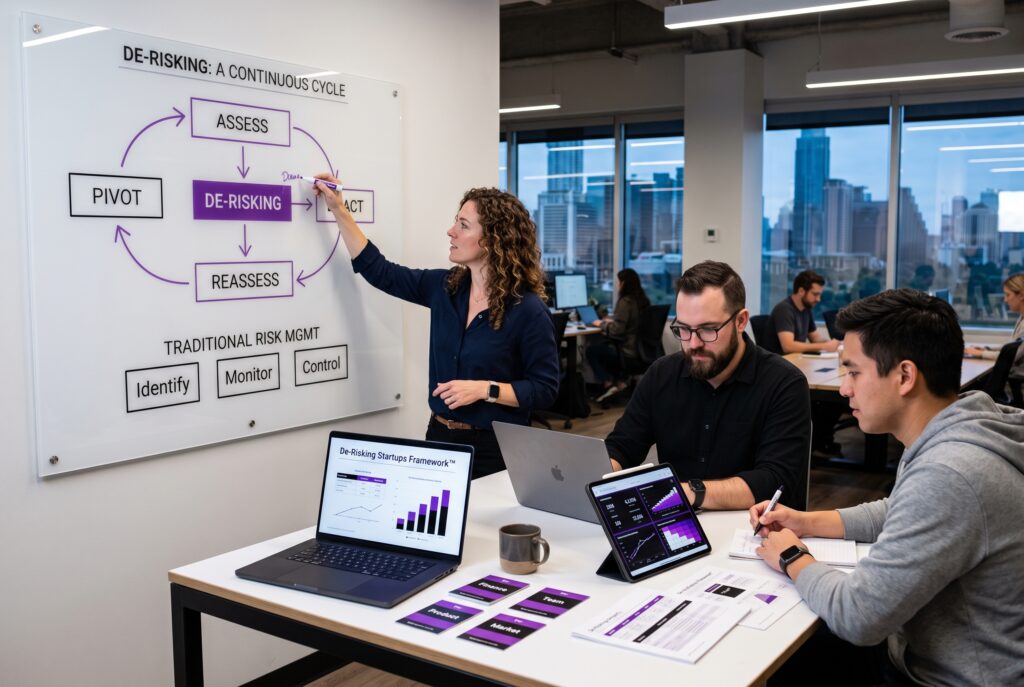
Traditional risk management can imply identifying and controlling a relatively stable set of risks. Startup de-risking is continuous because the startup itself is constantly changing. Reducing one risk can create or relocate another, and decisions that were appropriate at one stage can become dangerous as dependencies change.
Both startup risk management and startup de-risking are concerned with uncertainty and potential problems. The difference is primarily in how they understand the environment in which those risks exist.
Traditional risk management often begins by identifying known risks, estimating their probability and potential impact, defining mitigation strategies, and monitoring them over time. That approach can be valuable when the underlying system is sufficiently stable for the identified risks to remain meaningful.
Startups present a different problem. The company being evaluated today may be substantially different six months from now. The product changes, customers change, the team grows, capital is consumed, assumptions are validated or rejected, and every significant decision creates new dependencies.
Startup de-risking is designed around that reality.
Startup Risk Is Not Static
Imagine a startup with a small team, limited revenue, and significant runway. At that moment, hiring additional employees may reduce execution risk because the company lacks critical capabilities.
Six months later, the company has doubled its team while revenue has grown more slowly than expected. The hiring strategy that originally reduced Team and Product risk may now be contributing to Finance risk through higher burn and shorter runway.
The original decision was not necessarily wrong.
The system changed.
This is one of the central ideas in Juan Damia’s De-Risking Startups Framework™: a startup cannot simply identify its risks once and then manage the resulting list. It must continuously reassess how the company itself is changing.
Reducing Risk Can Relocate Risk
In a startup, solving one problem frequently changes conditions elsewhere.
A company struggling with slow product development hires more engineers. Development capacity increases, but so does burn.
A startup concerned about customer concentration aggressively pursues new accounts. Concentration decreases, but customer acquisition costs may increase and operational complexity may grow.
A founder delegates more decisions to eliminate a leadership bottleneck. Decision-making becomes more scalable, but unclear authority may create coordination problems.
In each case, the intervention may successfully reduce the original risk while creating or increasing another.
This is why startup de-risking cannot be understood as a sequence of risks that are identified, fixed, and permanently removed.
The more useful cycle is:
Assess → Identify → Prioritize → Act → Learn → Reassess
Reassessment is essential because every meaningful intervention can alter the company’s risk structure.
Stage Changes the Meaning of Risk
Startup risk is also highly dependent on context.
Founder-led sales can be an advantage when the company is discovering its market. The founder learns directly from customers, understands objections, tests positioning, and develops an initial sales process.
Later, if every significant sale still requires the founder, the same behavior may become a scalability problem.
Informal communication may be highly efficient with five employees but create confusion with fifty. Technical shortcuts may be appropriate when validating a product but dangerous once customers depend on the system. Customer concentration may help an early startup generate its first meaningful revenue but become a major dependency as the company grows.
The behavior itself is not automatically good or bad.
Its risk depends on the system surrounding it.
This means a startup cannot assume that because a decision was appropriate before, it remains appropriate now.
De-Risking Is Continuous
This is where continuous de-risking becomes fundamentally important.
A startup assessment provides a snapshot. De-risking requires understanding the trajectory.
What changed?
Which assumptions have been validated?
Which remain unresolved?
Which risks decreased?
Which increased?
What new dependencies were created?
Did an intervention produce the intended result?
Did reducing one risk create another?
These questions need to be revisited because startups operate in motion.
The purpose is not simply to maintain a register of potential problems. It is to continuously update the company’s understanding of where risk is forming.
De-Risking Focuses on Learning
Startup de-risking also places particular importance on learning.
Startups begin with assumptions because they do not yet have enough evidence to know exactly how their business will behave. The company reduces uncertainty by confronting those assumptions with evidence and changing decisions when necessary.
This means that activity alone does not necessarily reduce startup risk. Neither does simply recognizing that a risk exists.
Risk is reduced when learning changes what the company does.
A market assumption becomes less risky when customer evidence clarifies whether it is correct. A product assumption becomes less risky when actual behavior provides evidence about value. An operational assumption becomes less risky when the startup demonstrates that a process can be repeated.
The purpose of de-risking is therefore not merely to protect the company from negative outcomes. It is to reduce uncertainty through learning while the cost of changing direction remains manageable.
De-Risking Preserves Optionality
Another important distinction is optionality.
If a risk is identified early, founders often have several possible responses. They can test an assumption, modify a product, slow hiring, change pricing, adjust spending, alter a process, or simply continue monitoring the situation.
If the same risk is identified after capital has been spent, teams have been hired, technology has been built, and runway has shortened, many of those options may have disappeared.
This is why startup de-risking emphasizes early recognition rather than waiting for certainty.
The objective is not to eliminate every risk as soon as it appears. It is to understand important risks early enough that the startup can choose an appropriate response while choices still exist.
From Risk Control to an Operating Habit
The distinction between startup risk management and startup de-risking is therefore more than terminology.
Startup de-risking treats risk as dynamic, systemic, interconnected, and time-dependent. It recognizes that the startup itself is continuously changing and that every meaningful decision can alter its risk structure.
Rocketbeet operationalizes Juan Damia’s De-Risking Startups Framework™ around this continuous process across Founder, Team, Market, Product, Business Operations, and Finance. Startups are assessed, risks are identified and prioritized, actions are defined, evidence is generated, and the company is reassessed as conditions change.
The goal is not to produce a static picture of startup risk.
It is to make de-risking an operating habit.
Startup risk management asks how identified risks should be managed. Startup de-risking continuously asks how the company’s changing decisions, assumptions, and dependencies are changing the risk itself.